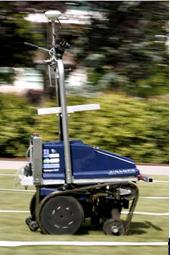
The Robotic Vision Lab endeavors to reach new frontiers in the field of robotic vision, through building a strong foundation of essential basics to both graduate and undergraduate students while encouraging creativity and dedication to expand on those basics. Dr. D.J. Lee and Dr. James Archibald supervise and inspire the efforts of the Robotic Vision Lab.
Autonomous robots are robots which can perform desired tasks in unstructured environments without continuous human guidance. Many kinds of robots are autonomous to some degree. Different robots can be autonomous in different ways. A high degree of autonomy is particularly desirable in fields such as space exploration, where communication delays and interruptions are unavoidable.
Some modern factory robots are "autonomous" within the strict confines of their direct environment. Maybe not every degree of freedom exists in their surrounding environment but the work place of the factory robot is challenging and can often be unpredictable or even chaotic. The exact orientation and position of the next object of work and (in the more advanced factories) even the type of object and the required task must be determined. This can vary unpredicatably (at least from the robot's point of view). From the start, factory robots have not been subject to continuous human guidance or necessarily any human guidance at all.
One important area of robotics research is to enable the robot to cope with its environment whether this be on land, underwater, in the air, underground or in space.
A fully autonomous robot in the real world has the ability to:
Gain information about the environment.
Work for months or years without human intervention.
Travel from point A to point B, without human navigation assistance.
Avoid situations that are harmful to people, property or itself.
Repair itself without outside assistance.
A robot may also be able to learn autonomously. Autonomous learning includes the ability to:
Learn or gain new capabilities without outside assistance.
Adjust strategies based on the surroundings.
Adapt to surroundings without outside assistance.
Autonomous robots still require regular maintenance, as do other machines.
(Information from Wikipedia)